
Monday, 9:02 AM.
Your CFO reopens RiskRegister_v12_FINAL_corrected.xlsx. Three tabs are hidden. A formula returns #REF!. Nobody knows who edited the "Residual Impact" column last week. The external auditor arrives in ten days.
If that scene sounds familiar, you're not alone. More than 70% of mid-sized companies still run their risk management on spreadsheets. Until regulations caught up, that was fine.
But in 2026, three things have changed:
- regulations have stacked up (NIS2, DORA, CSRD, AI Act, data-protection laws from the UAE PDPL to the Saudi PDPL),
- auditors now demand traceable evidence,
- and cyber-incidents cost affected companies $4.88M on average (IBM, 2024).
A spreadsheet isn't robust enough anymore because risk management has become a system, and a system can't be piloted through a flat file.
Here's what we observe with the SMEs we work with across EMEA and what a native Odoo GRC platform changes in practice.
The 7 fatal limits of an Excel risk register
1. No reliable versioning
Who edited what, when, why? Excel's history is unreliable, unstructured, and easily disabled. A NIS2 or ISO 27001 auditor will ask for a multi-year audit trail. You won't have it.
2. No automatic audit trail
Every risk assessment must be timestamped, signed, attributable. Excel can't prove who validated what. Manual "Validated by" columns prove nothing.
3. No approval workflow
An identified risk must follow a sequence:
Assessment → manager review → approval → treatment plan → follow-up.
In Excel, that entire workflow lives across scattered emails. When an auditor asks "where's the evidence of approval for risk R-2025-047?", the answer is a mess of email threads.
4. No link between assets, controls, and regulations
Core GRC rule: every control answers a risk, which sits on an asset, which is governed by a regulation. That triangle is audit bedrock. Excel can't model it cleanly — you end up with five spreadsheets that don't talk to each other.
5. Impossible to prove multi-framework compliance
You're subject to NIS2 and GDPR and ISO 27001? One control — "MFA on admin accounts" — addresses all three. In Excel, you document it three times. Three divergent versions. Three contradictory audits.
6. Duplication across entities and departments
The moment you have two sites or two subsidiaries, registers duplicate, diverge, contradict. No consolidated real-time view is possible.
7. Single-person dependency
Nine times out of ten, only one person knows how the file works. If they leave, your governance memory leaves too.
What an auditor actually looks at in 2026
A NIS2, DORA, or ISO 27001 audit doesn't assess the content of your register. It assesses your capacity to prove that the register reflects reality. Four things are always required:
- End-to-end traceability, from regulation to tested control, via the risk and the asset.
- Timestamping and attribution: who assessed, validated, tested, when.
- Evidence: screenshots, exports, tickets, attached to every tested control.
- Lifecycle proof: is a risk re-assessed on a defined frequency? Can you show it?
Excel produces none of these natively. Reconstructing them ahead of an audit costs on average 40 to 80 hours — time that should have gone into actual risk reduction, not documentary archaeology.
The 5 pillars of a modern GRC (and how Prism GRC embodies them)
Pillar 1 — Asset mapping
Before mapping and managing risks, you need to know what you're protecting.
Prism GRC registers critical assets (IT systems, databases, departments, suppliers, processes) with a parent/child hierarchy that mirrors your org chart. Departments import from Odoo HR in one click. Each asset carries a live compliance rate.
Pillar 2 — Structured risk assessment
Each risk follows a three-step cycle:
Inherent risk → residual risk → target risk.
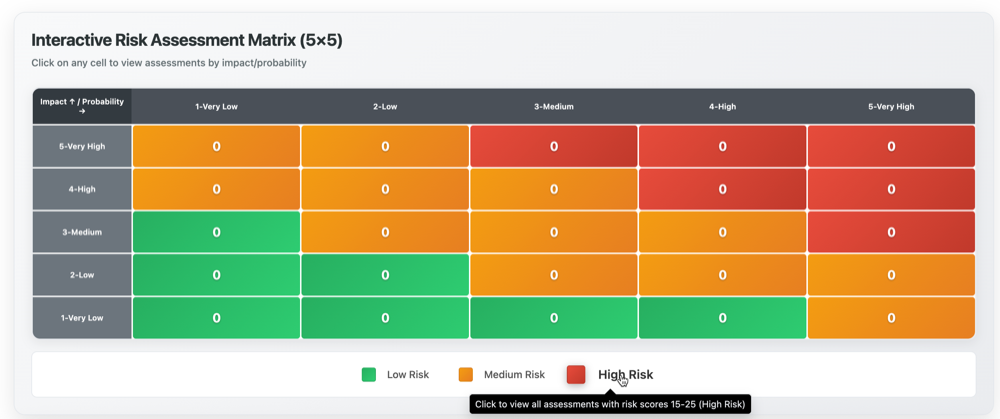
An interactive 5×5 matrix shows the full landscape with a configurable risk appetite threshold. Click any cell to drill down.
Pillar 3 — Treatment plans
For every risk above appetite, four structured options: Mitigate, Transfer, Avoid, Accept. Each treatment has an owner, a deadline, tracked progress and links back to the original assessment for full traceability.
Pillar 4 — Control library and testing
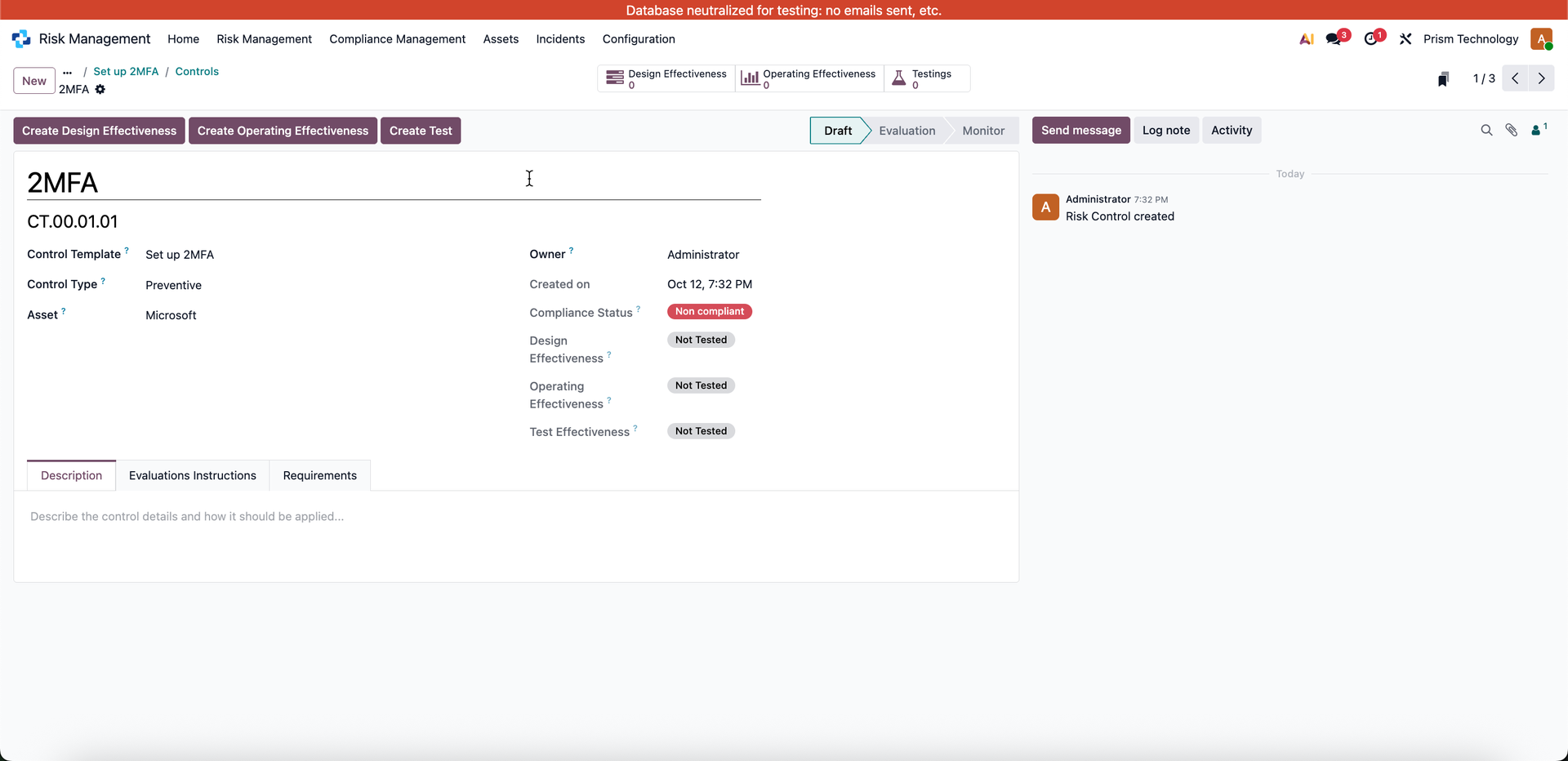
Controls are measured on three levels: design effectiveness, operating effectiveness, and testing ("pass/fail" with evidence). A well-managed control is a tested control. Templates let you deploy a standard across all your assets in minutes.
Pillar 5 — Incidents and continuous improvement
When something goes wrong, log the incident, run root cause analysis, assess impact, define corrective actions. Incidents link to affected assets, making it possible to spot patterns over time and strengthen controls where they give way.
Under NIS2, significant incidents must be reported to authorities within 24 hours. Prism GRC's incident log gives you the structured evidence to do that — and to show auditors the corrective loop was closed.
Why "native on Odoo" changes the game
This is where we leave the territory of standard GRC tools. Most platforms live in a silo: an isolated SaaS portal, with its own SSO, its own user directory, its own exports to rework before board meetings. Adoption suffers. ROI struggles to materialize.
Prism GRC is natively embedded in Odoo:
- Your HR departments become assets in one click — no duplicate lists.
- Your projects display their risk exposure directly — PMs see GRC risks without switching tools.
- Odoo's chatter tracks every risk, control, and audit — discussions live where the data lives.
- Odoo's access rights (User, Manager, Auditor, Administrator) apply natively.
- No new tool to train on — teams already on Odoo adopt Prism GRC rapidly.
The outcome: governance stops being an isolated department and becomes a control layer sitting on top of real operations. Exactly what modern auditors are now asking for.
Cover DORA, NIS2, GDPR, ISO 27001, and more on one platform
Prism GRC supports the frameworks SMEs in Europe and MEA actually need.
Import the regulation, break it down into requirements, map each requirement to a control. The platform computes your compliance rate per framework in real time. You always know where you stand — and where the gaps are.
One control can cover several frameworks including CYFUN for Belgian entities. One document. One piece of evidence. One audit.
Calculate your ROI in 10 minutes
Illustrative example:
Take an 80-employee industrial SME, typical of our customer base:
- Time saved per audit: 60 hours × 2 audits/year = 120 hours, roughly €9,000 of internal cost.
- NIS2 fine risk avoided: up to €10M or 2% of turnover. Even at low probability, expected avoided cost dwarfs platform cost.
- Compliance team capacity: 1-2 partial FTEs freed from data entry to do actual risk work.
- B2B sales cycles: large customers increasingly require governance evidence in RFPs. A clean register wins deals faster.
A native Odoo GRC typically pays back in under a year, and gets you out of permanent firefighting mode.
Take action
You can keep opening "RiskRegister_v12_FINAL_corrected.xlsx" every Monday or you can take 30 minutes to see what your risk map looks like on a modern platform.
Prism GRC is a native Odoo module that installs on your existing environment.
👉 Book your 30-minute demo Contact us